Key takeaways
- Confirm shipping requirements for the exact material.
- Prepare storage and receiving records before delivery.
- Assess excursions using evidence, not the feel of the package.
For laboratory research education only. Not medical advice or instructions for human or animal use. RetaSet supplies research materials and publishes this guide; catalog links lead to our own products.
Before dispatch: agree on the handling requirements
Check the supplied form, packaging and documented transport conditions before arranging delivery. Lyophilized and solution products should not be assumed to have identical requirements. Ask what information supports the shipping method and what to do if delivery is delayed.
A laboratory receiving plan should name the person who accepts the shipment, the storage location and the escalation contact. Scheduling matters: a suitable package can still be left unattended if nobody knows it is arriving. Resolve access restrictions and receiving hours ahead of time.
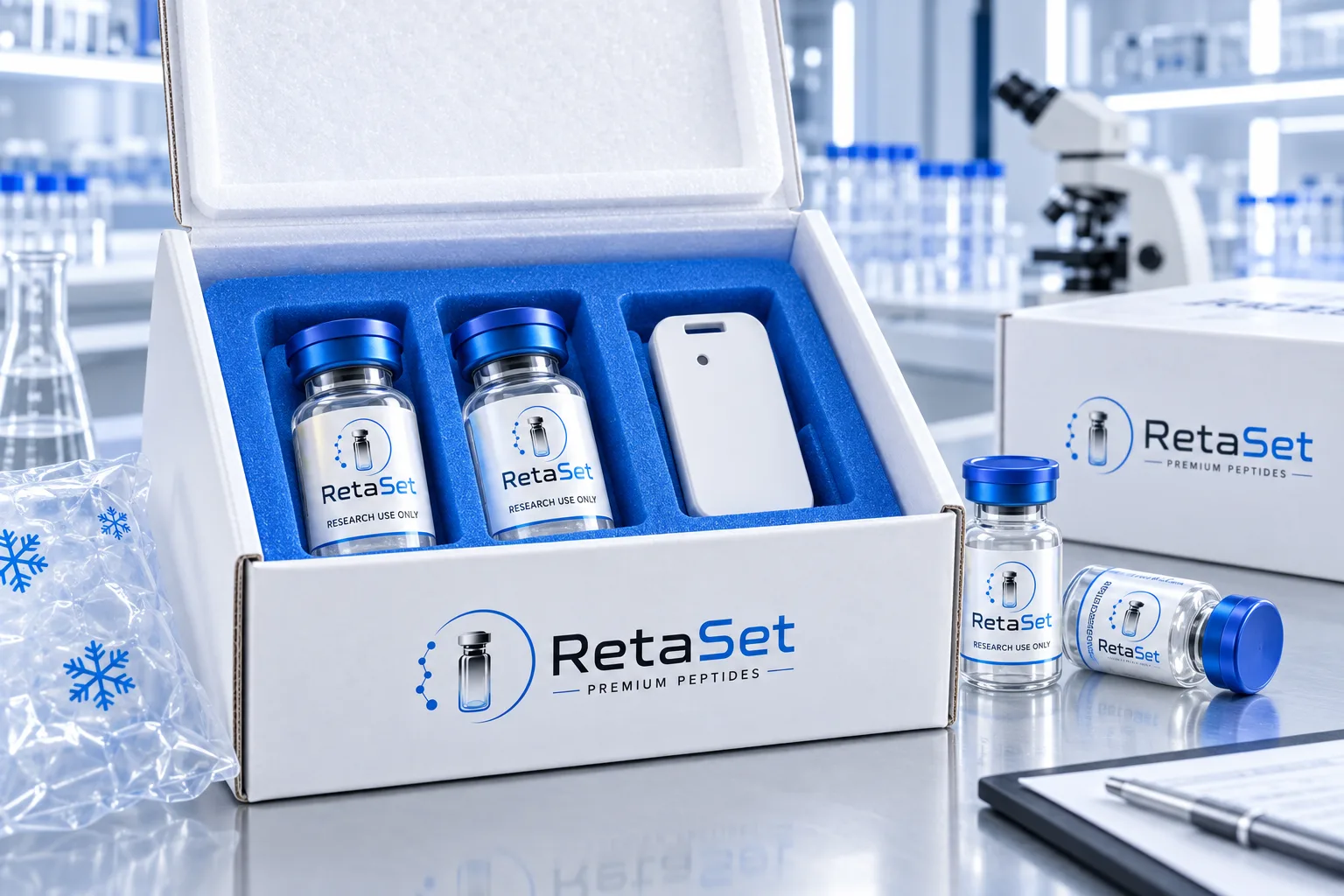
What cold-chain packaging does and does not prove
Insulation and refrigerants are tools for managing exposure. They are not analytical tests. Likewise, a temperature logger records conditions at its sensor; interpretation still depends on the packaging arrangement and the material’s acceptable exposure limits.
Do not create a universal rejection rule from a single snapshot temperature. A justified acceptance decision needs the relevant specification and available transit information. When that information is missing, record the uncertainty and obtain a disposition from the responsible team.
A receiving checklist for research peptides
Use a consistent checklist so each delivery produces a traceable record. These are proposed receiving steps, not a claim about RetaSet’s packaging or shipping service.
- Record arrival date, time, order number and carrier reference.
- Inspect the outer package, seal and containers for visible damage.
- Match the received product and lot identifiers to the order and documentation.
- Save any available temperature record and photographs of concerns.
- Move the material to its documented storage conditions promptly.
- Log discrepancies and keep questionable material separate pending assessment.
How to document a temperature excursion
Record what is known: estimated duration, measured temperatures, sensor location, product form and condition on arrival. Separate measured facts from assumptions. For example, a delayed tracking scan does not tell you the temperature inside the package.
Ask the supplier for product-specific excursion information and preserve their response with the batch record. If a laboratory investigation is needed, define the analytical question before testing. Returning a vial to cold storage does not, by itself, reverse any changes that occurred.
Complete the handover into laboratory inventory
Assign an internal identifier and link it to the lot documentation. Record where the material is stored and who received it. This makes it possible to connect a later assay concern with the relevant delivery and handling history.
For subsequent preparation, follow the material’s handling instructions. Manufacturer guidance emphasizes that conditions depend on the peptide; generic online rules are not a substitute for the supplied specification. Consult RetaSet’s shipping policy for the store’s current order terms.
Common questions
Must every research peptide ship on ice?
Not necessarily. The appropriate shipping method depends on the product form and supported transport conditions. Confirm the specification.
Does a melted cold pack mean the peptide is damaged?
It does not prove either damage or acceptable integrity. Review available transit data and the product’s documented limits.
Explore research materials
Review research products and clarify their handling requirements before ordering.
Product links support research procurement only. Availability and specifications can change. Contact RetaSet for missing product documentation. Read the shipping policy.