Key takeaways
- Mass concentration and molar concentration answer different questions.
- The mass entered must match the analytical definition in the lot documentation.
- A correct calculation does not verify dissolution, stability, sterility or biological activity.
For laboratory research education only. Not medical advice or instructions for human or animal use. RetaSet supplies research materials and publishes this guide; catalog links lead to our own products.
Choose the quantity before entering numbers
“Concentration” is incomplete without a unit. Mass concentration reports how much mass is present per volume, for example mg/mL. Molar concentration reports amount of substance per volume, commonly mol/L or one of its scaled units. Converting between them requires the molar mass of the specified chemical entity.
NIST distinguishes these quantities explicitly. In a research worksheet, use a separate heading for each rather than a single column labeled “strength.” A numerical result of 0.5 is not interpretable until the quantity and unit are known.
For the equations here, m is the documented mass of the specified peptide, V is final solution volume and MW is molar mass in g/mol. The calculator must use the same chemical entity for m and MW. A value for a salt-inclusive material cannot be substituted casually for one defined on a peptide-only basis.
| Output wanted | Equation with stated units | Extra information needed |
|---|---|---|
| Mass concentration (mg/mL) | m (mg) ÷ V (mL) | A defensible peptide mass |
| Molar concentration (mol/L) | m (g) ÷ [MW (g/mol) × V (L)] | Molar mass on the same chemical basis |
| Concentration after dilution | C2 = C1 × V1 ÷ V2 | Consistent concentration units and volume units |
Worked example: the same mass is not the same molarity
Imagine a fictional analytical reference peptide with a documented peptide mass of 2.0 mg, a molar mass of 2,000 g/mol and a final solution volume of 4.0 mL. These figures were chosen for arithmetic clarity and do not describe a RetaSet product.
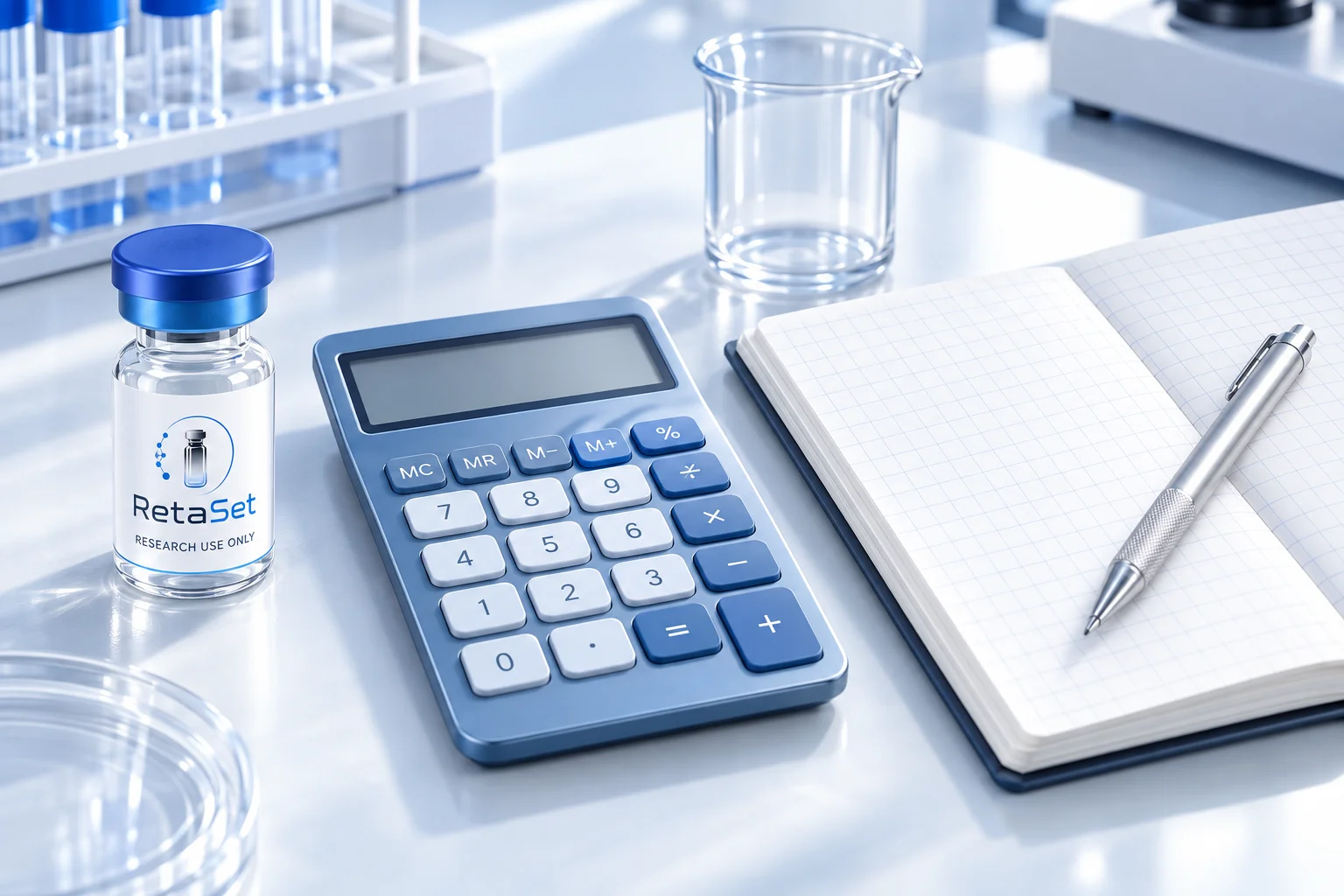
Mass concentration is 2.0 ÷ 4.0 = 0.50 mg/mL. For molarity, convert 2.0 mg to 0.0020 g and 4.0 mL to 0.0040 L. The result is 0.0020 ÷ (2,000 × 0.0040) = 0.00025 mol/L, or 0.25 mmol/L, also written 250 µmol/L.
Now hold the mass concentration at 0.50 mg/mL but imagine a second peptide with a molar mass of 4,000 g/mol. Its molarity is 0.125 mmol/L. Equal mass concentrations therefore do not provide equal numbers of molecules per volume.
This is an arithmetic comparison, not a prediction of biological response. It helps explain why a paper reporting an assay in micromoles per litre cannot be matched solely by copying a mass-per-volume figure from another compound.
The mass field deserves a closer look
Gross powder mass can include water, counterions and residual material in addition to peptide. Sigma-Aldrich’s technical guidance distinguishes gross weight, net peptide content and peptide purity. An HPLC purity percentage is not automatically a measurement of how many milligrams of target peptide are present in the container.
Bachem’s calculator uses its lot-specific analytical definitions for purity and assay to estimate absolute peptide weight from gross weight. That is a documented convention for its analytical data sheets. Do not copy the correction into another supplier’s calculation until the meanings of the fields are confirmed.
Here is a second fictional example, using a different kind of input: a report explicitly states a target-peptide mass fraction of 0.80 g/g, already accounting for the report’s relevant corrections. A 3.0 mg sample then represents 2.4 mg of target peptide on that stated basis. Applying another purity factor without checking the definition could count the same correction twice.
If the report only gives chromatographic purity, leave the target-mass estimate unresolved until suitable content information is available. Thermo Fisher’s amino-acid-analysis technical note illustrates why content determination is an analytical measurement in its own right. A calculator cannot supply missing laboratory data.
Check dilution against the final volume
For a simple dilution calculation assuming complete mixing and no loss or reaction, the amount transferred is conserved: C1 × V1 = C2 × V2. Here V1 is the volume of stock represented in the calculation, while V2 is the final total volume. Both volumes must use the same units, and both concentrations must use the same basis.
As a fictional worksheet check, 0.20 mL of a 1.0 mmol/L analytical stock represented in a final volume of 2.0 mL gives 0.10 mmol/L. The volume has increased tenfold relative to the aliquot, so the concentration falls tenfold. That quick ratio check can catch a misplaced decimal.
The word “final” matters. In that example, 2.0 mL is not an additional volume placed on top of the 0.20 mL aliquot. Confusing the two changes the denominator. Actual laboratory preparation must follow the material-specific procedure, including its solvent and volume conventions; this example only checks conservation arithmetic.
Before saving the result, save its assumptions
A useful calculation record lets another reader reconstruct the result. Record the lot identifier, the source and definition of the mass, the molar-mass basis if used, the final volume, all units and any corrections. Retain the unrounded calculation internally, then report a result that reflects the precision of the inputs.
Try a directional check before accepting a result: doubling volume with a fixed peptide amount should halve concentration. Doubling molar mass at a fixed mass concentration should halve molarity. If your worksheet does the opposite, inspect the formula and unit conversions.
Finally, separate calculated concentration from measured concentration. Incomplete dissolution, losses to surfaces or changes in the material can break an assumption even when the spreadsheet formula is correct. The calculation is a statement about defined inputs, not confirmation that the resulting sample meets an assay specification.
Common questions
Is mg/mL the same as mmol/L?
No. mg/mL expresses mass per volume; mmol/L expresses amount of substance per volume. Conversion requires the molar mass and a consistent definition of the material.
Can I enter HPLC purity as net peptide content?
Not without documentation establishing that meaning. Chromatographic purity and peptide content describe different measurements. Confirm the report’s definitions before applying any correction.
Does this guide calculate a personal dose or syringe setting?
No. These are fictional concentration and dilution examples for laboratory education. They do not establish a dose, administration method, solvent choice or preparation procedure for any product.
Explore research materials
Browse laboratory materials and request the lot-specific documentation your calculation needs. The hypothetical values in this guide do not describe the linked BPC-157 product or prescribe its preparation.
Product links support research procurement only. Availability and specifications can change. Contact RetaSet for missing product documentation. Read the shipping policy.