Key takeaways
- Retatrutide is one modified peptide molecule, not a mixture of three hormones.
- LY3437943 and CAS 2381089-83-2 are identifiers; neither is a test result.
- The molecular structure does not disclose every component or impurity in a particular vial.
For laboratory research education only. Not medical advice or instructions for human or animal use. RetaSet supplies research materials and publishes this guide; catalog links lead to our own products.
The chain and its chemical attachment
The published chemical description identifies a 39-residue peptide backbone. It includes the nonstandard amino-acid building block Aib at positions 2 and 20, and alpha-methyl-leucine at position 13. Its C-terminal end is amidated. These details belong to the molecule’s identity; they are not optional ingredients that can be swapped without changing that identity.
At lysine 17, a linker connects a C20 fatty-diacid group. The attachment promotes reversible albumin binding. Calling this a modified peptide captures both the amino-acid chain and the additional chemistry; describing it only as “39 amino acids” leaves part of the structure out.
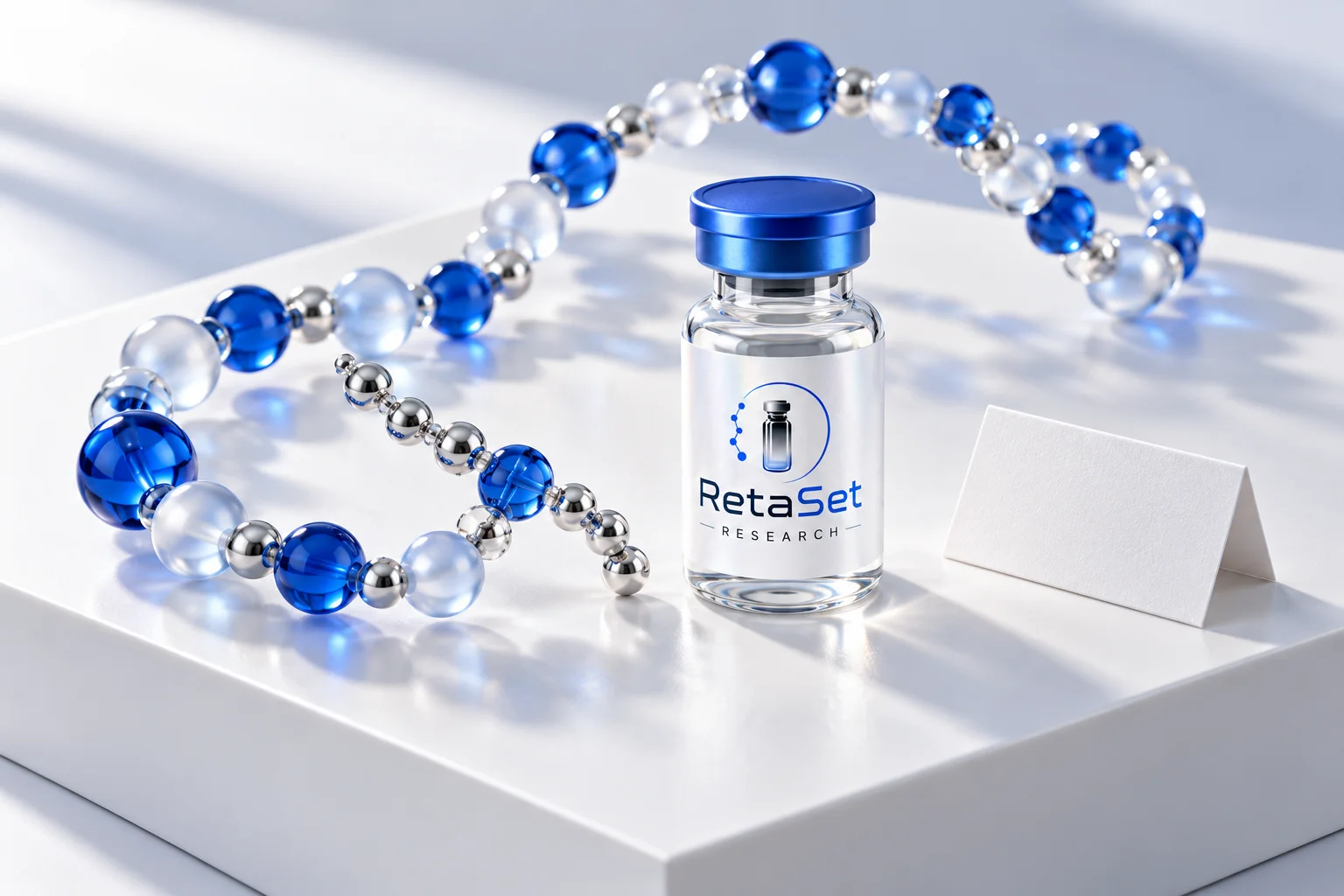
A bead illustration can make a chain easier to imagine, but it cannot specify stereochemistry, attachment sites or the analytical identity of a sample. The image accompanying this article is conceptual, not a chemical structure diagram.
Three targets do not mean three ingredients
Structural research has examined retatrutide bound to each of the GLP-1, GIP and glucagon receptors. Those are three biological targets for the same molecule. The phrase “triple agonist” does not describe a recipe made by combining three separate hormones.
Li and colleagues used cryo-electron microscopy to study these receptor complexes and identified both shared and receptor-specific interactions. Their sequence comparison also places the fatty-diacid attachment at lysine 17. The study helps explain how one structure can engage different receptors; it is not a specification for a finished commercial vial.
For a fuller discussion of receptor responses, see the related mechanism guide. Here, the important chemical point is that a target name and an ingredient name are different kinds of information.
Retatrutide CAS number and LY3437943: what they identify
The FDA GSRS substance record deposited in PubChem lists retatrutide with CAS number 2381089-83-2 and UNII NOP2Y096GV. The National Library of Medicine’s MeSH entry also associates retatrutide with the development code LY3437943. These identifiers help connect records that use different naming conventions.
For a literature search, try both retatrutide and LY3437943. For a document comparison, record the identifier alongside the stated chemical form. A matching number makes two documents easier to reconcile, but it does not show that anyone tested the supplied material.
Think of a catalog number printed on an instrument: it tells you which item is being claimed. It cannot, by itself, tell you whether the item delivered works correctly. Chemical identifiers have the same limit when they are simply copied onto a label.
The molecule is only one part of a vial’s composition
Bachem’s quality-control guidance distinguishes chromatographic purity from net peptide content. A peptide preparation can also contain water and counterions; a purity percentage is therefore not a complete inventory of the material. This general analytical distinction matters when interpreting a retatrutide specification.
The following is a document-reading checklist, not a claim about the composition of any RetaSet batch. Ask for the information relevant to your experiment rather than filling missing fields from a generic molecular entry.
| Record | Question it should answer | What to avoid assuming |
|---|---|---|
| Chemical identity | Which sequence, modifications and chemical form are specified? | A familiar name proves the supplied sample matches. |
| Composition | Are counterions, water or added excipients declared or measured as relevant? | Everything in the vial is peptide. |
| Quantity basis | Does the stated amount mean net peptide or another defined basis? | A purity percentage alone converts gross mass to peptide mass. |
| Lot evidence | Which measurements belong to this exact lot? | A paper about the molecule tests this batch. |
A practical example: the missing composition field
Imagine a hypothetical document headed “Retatrutide, 10 mg” with the expected CAS number and a chromatographic purity result. It gives no quantity basis and no composition statement. You can record the claimed identity and the reported purity. You cannot responsibly complete the missing fields with “10 mg net peptide, no other components.”
A useful follow-up would be: “Please specify the chemical form, the basis of the 10 mg claim, and which composition measurements or declarations apply to this lot.” That question is more precise than asking whether the product is “pure,” because it identifies what the laboratory record still needs.
This is also why copying a molecular formula from a database cannot resolve a vial-content question. A reference describes an entity; the supplier’s lot documents must describe the supplied material.
Keep chemical identity separate from clinical status
As checked on 6 October 2026, Lilly describes retatrutide as investigational and not available for public use, with clinical development ongoing. An identifier in a chemical database does not confer medicine approval.
For laboratory procurement, review the specific listing and its available documents against your project requirements. Research materials are not substitutes for an approved treatment or the investigational product supplied in a clinical trial.
Common questions
What is reta made of?
If “reta” means retatrutide, it refers to a modified 39-residue peptide with a fatty-diacid attachment. A vial’s full composition requires its own specification and lot documentation.
Does a retatrutide CAS number prove authenticity?
No. CAS 2381089-83-2 helps identify the substance named in a record. Printing that number does not establish the identity, content or quality of a supplied sample.
Explore research materials
Explore the Research Peptide Catalog for laboratory listings and available specifications. Check the stated chemical form and lot documentation; molecular reference information does not establish a product’s suitability for human use.
Product links support research procurement only. Availability and specifications can change. Contact RetaSet for missing product documentation. Read the shipping policy.